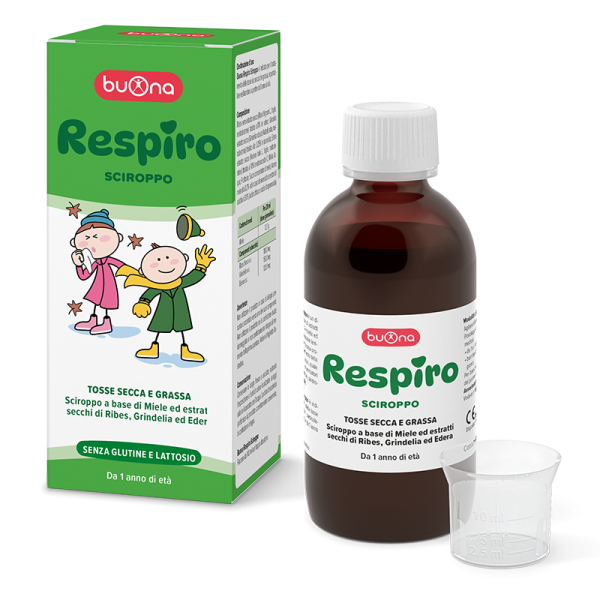

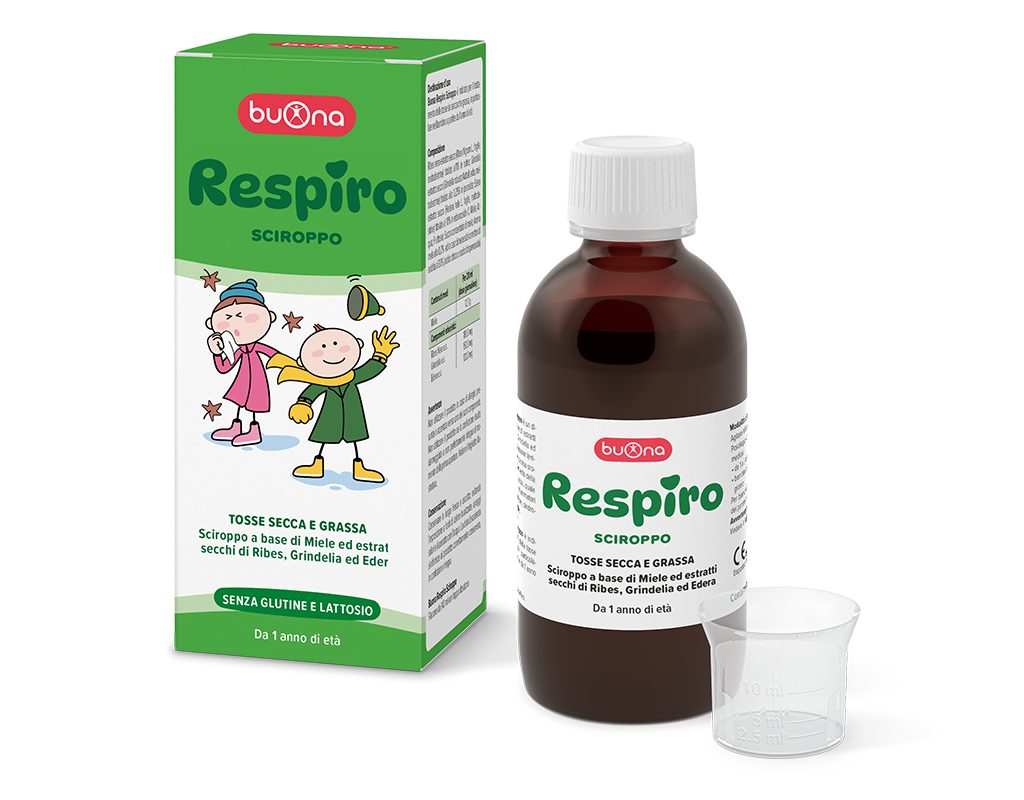
Buona Respiro Syrup
€17,90
A syrup for the treatment of dry and chesty coughs, containing Honey and dry extracts of Blackcurrant, Grindelia and Ivy
Package
140 ml bottle with measuring cup
Does not contain gluten or lactose.
From 1 year of age
Buona Respiro Syrup is a medical device CE 0546.
Read the instructions and warnings carefully.
AUT. MIN. 15/06/2022
Buona Shipping | |
CONDIZIONI | COSTO |
Ordini inferiori a € 49,00 | € 6,00 |
Ordini superiori a € 49,00 | GRATIS |
Ordini superiori a € 29,00 | GRATIS |
Box Promozionali | GRATIS |
Acquisto di 1 confezione di Ugo e l'Olio | € 1,99 |
SPEDIZIONE GARANTITA: 3-5 GIORNI LAVORATIVI | |
Buona Respiro Syrup is a medical device based on plant extracts (Blackcurrant, Grindelia and Ivy) and honey.
Buona Respiro Syrup has a soothing and protective action on the oropharyngeal mucosa and is useful in the treatment of both dry and productive coughs associated with inflammatory processes resulting from colds, flu-like illnesses and pharyngitis.
Thanks to the presence of resins, polysaccharides, mucilages and flavonoids, it acts in cases of:
- Dry cough, by forming a protective film over the irritated mucosa, shielding it from contact with external irritants. Buona Respiro Syrup reduces the urge to cough, thereby promoting hydration and lubrication of the mucosa and reducing friction in the pharynx that can trigger coughing;
- Productive cough, by promoting the physiological removal of mucus, with an emollient and mucus-thinning effect.
Buona Respiro Syrup provides a soothing sensation to irritated mucosa, helping to restore normal function of the upper respiratory tract and helping to prevent inflammatory processes. The formulation is enriched with Honey and Apple juice, making the syrup particularly pleasant for children.
Composition
Blackcurrant dry extract (Ribes nigrum L., leaves, maltodextrins); Grindelia dry extract (Grindelia robusta Nuttall, herb, maltodextrins); Ivy dry extract (Hedera helix L., leaves, maltodextrins); Honey; Water; Fructose; Concentrated apple juice; Apple flavouring 0.2% and, if necessary, 30% acidity regulators (citric acid or sodium hydroxide).
Gluten-free. Lactose-free.
| AVERAGE CONTENTS | Per 20 ml (daily dose) |
|---|---|
| Honey | 12.7 g |
| HERBAL INGREDIENTS | |
| Blackcurrant dry extract | 180.0 mg |
| Grindelia dry extract | 150.0 mg |
| Ivy dry extract | 120.0 mg |
How to use
Shake the bottle before use.
Recommended dosage, unless otherwise advised by a doctor:
- From 1 to 3 years: 5 ml up to twice a day;
- Over 3 years and adults: 5 ml up to 4 times a day.
For children under 3 years of age, administer only after consulting a doctor.
It may be useful to administer the last dose before bedtime.
Wash the measuring cap after each use and make sure the bottle is properly closed.
Once opened, use within three months.
Buona Respiro Syrup can be taken as is or diluted, as desired, in a small amount of liquid, including lukewarm liquids (milk, tea, water).
Information
When creating the formulation for Buona Respiro Syrup, we selected dried, titrated and standardized extracts of plants known for their calming effects on both dry and chesty coughs, and their capacity to protect the oropharyngeal mucosa.

Grindelia, a plant belonging to the Asteraceae family that grow predominantly in the Americas, contains a resin with mucoadhesive and protective properties that favour the formation of a protective film, this produces a barrier effect that can soothe coughs. This protects the upper respiratory tracts against contact with external irritants.

Ivy, a plant belonging to the Araliaceae family, contains a high concentration of flavonids, which contribute to the elimination of mucus by exerting and fluidifying effect on bronchial secretions.

Blackcurrant, a woody shrub of the Gossulariaceae family, is native to temperate, hilly areas in central and northern Europe that enjoy a relatively damp climate. It contains tannins, flavonoids and procyanidins that have antioxidant effects (anti free radicals).

Thanks to its high sugar content, Honey produces mucoadhesive, protective and soothing effects on the oropharyngeal mucosa.
Honey is by far the most well-known product of commercial bee farming.
It comes from the nectar collected by worker bees foraging in the flowers of many plant species. The worker bees begin transforming nectar into honey immediately after the harvest it from the flower; the process takes place inside the honey sac, where enzymes are added
to the sugar solution contained in the nectar. Then continues inside the hive, where the “house bees” (young workers who have only emerged during the preceding 21 days) continuously ingest and regurgitate the honey, with frequent exchanges between different workers, resulting in a gradual maturing
and enrichment process of enzymes derived from glandular secretions of the bees themselves
and a progressive reduction of excess water contained in the nectar, so as to avoid the risk of the honey fermenting.
When ripe, honey is mainly composed of:
- Carbohydrates 80-82%
- Water 15-18%
- Enzymes, polyphenols, vitamins, minerals, trace elements (1-3%).
The composition of honey varies depending on the characteristics of the nectar used to produce it, and it is possible to distinguish between each single-flower honeys, produced using nectar from a single plant species, and so-called thousand-flower honey, produced from nectar harvested from many different species of plants.
Regardless of the specific differences associated with the origin of the nectar, honey is a highly nutritional food source that is easily assimilated, and provides multiple benefits.
SOME SURPRISING FACTS ABOUT BEES

| 50-60,000 The number of bees living in a single colony, all seasons |
50 days The average life span of a worker bee, during the productive season |
| 5 years The life span of a queen bee |
2000 The number of eggs laid by a queen bee in a day |
| 80 The number of times her own body weight the queen bee consumes in royal jelly |
29 Km/h The maximum speed of flight of a bee |
| 150,000 km The distance a single bee would need to fly in order to produce 1 kg of honey (almost 4 times the circumference of the Earth!) |
60,000 The number of flights between the hive and flowers in order to produce 1 kg of honey |
| 3 km The radius around the hive for harvesting nectar (equivalent to 3000 hectares, or 4000 football pitches!) |
225,000 The number of flowers visited in 1 day by the bees from a single hive |